
How to Turn a Benchmark Gap Into a Test Plan
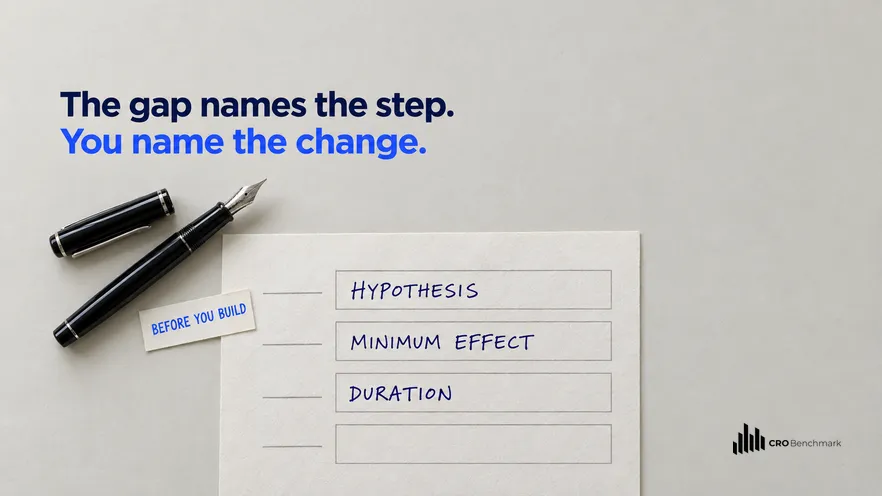
A test plan is defined as a written commitment made before a test is built, naming the hypothesis, the primary metric, the minimum effect worth detecting, the duration, the segment and what each outcome will cause you to do. A benchmark gap cannot supply any of those six fields: it identifies a step and nothing more, because a dozen different causes produce the same gap. The CROBenchmark dataset scores 7,000+ websites against 248+ audit criteria [CROBenchmark Report 2026, Omniconvert]. This guide shows how to translate a benchmark gap into a plan you can run.
- Read a gap as naming a step, not a cause, since a dozen causes produce the same gap.
- Write one falsifiable hypothesis: a change, an audience and a direction, in one sentence.
- Size the test before building it, and abandon any test that needs longer than the change stays relevant.
- Commit in advance to what a win, a loss and a flat result will each cause you to do.
- Decide faster with less proof when you are below significance, rather than running an underpowered test.
Last updated: October 2026 · By The CROBenchmark Team
The gap is the easy part. You compare a funnel step to its category figure, find you are several points behind, and the finding feels like an instruction. It is not. A gap at a step is consistent with a dozen different causes, and the step between noticing it and designing a change is where almost all the value and almost none of the attention goes.
What a test plan is, and what a gap cannot tell you
Take a cart-to-checkout rate sitting well below the category figure. That single gap is equally consistent with a shipping cost first revealed at the cart, a required account, a slow-loading page on mobile, a checkout control that does not look like a control, a promotional code field sending people off to hunt for codes, and a cart that silently empties between sessions. Six causes, six different fixes, one identical symptom.
So a gap is a search instruction. It tells you which room to look in, and the sequencing work of deciding which room is worth searching first is covered separately in benchmarks should shape your test roadmap. This piece assumes you have chosen the room and starts with what happens when you walk in.
The six fields a plan needs are the hypothesis, the primary metric, the minimum detectable effect worth caring about, the duration, the segment, and the decision rule for each outcome. Writing them down before building is not bureaucracy. Each field, filled in honestly, kills a certain number of tests at the cheapest possible moment, which is before anybody has built anything.
From benchmark gap to hypothesis: the translation that gets skipped
The translation has two halves, and the first is observation rather than analysis. Filter session recordings to the segment and the step where the gap sits, narrowed to sessions that reached the step and left. Watch twenty. You are looking for a repeated behaviour: a scroll that hunts for something, a pause, a repeated tap on something that is not a control, an exit immediately after a particular element appears.
Then add the cheapest evidence source in your business, which is the questions customers already asked. Pre-purchase support tickets about the product or the step are a written record of what your pages failed to answer, and they take twenty minutes to read. Where a recording shows hesitation and a ticket names the reason, you have two independent sources agreeing, which is the strongest position you can be in before testing anything.
Only now write the hypothesis, and write it so it could be wrong. Showing the delivery date above the cart control will reduce abandonment for mobile first-time visitors is falsifiable: run it, and the result either supports it or does not. Improving clarity at the cart is not, because no outcome would settle it. Unfalsifiable hypotheses are the main reason a test result produces a debate rather than a decision, since everyone can read a flat result as consistent with their prior view.
Sizing the test before you build anything
Sizing is the field teams skip, and skipping it is how a store ends up with a test that has been running for eleven weeks and still cannot be read. Shopify's own documentation on store conversion reporting is worth checking first, because the weekly conversion figure the calculation needs has to come from the same definition you will read the result against. The calculation is less intimidating than it sounds and the first input is a judgment, not a number: what is the smallest improvement that would actually change what you do? If a one percent relative lift would not justify keeping the change, you do not need to detect one.
Three sizing errors recur. Running a test on a step with too little volume and reading it early, which is statistically equivalent to guessing while feeling rigorous. Testing a change whose honest expected effect is tiny on a step that cannot detect tiny effects. And stacking multiple changes into one variant so that a win cannot be attributed, which trades the learning for a slightly better chance of a measurable result. The first is the dangerous one, because it manufactures false confidence rather than merely wasting time.
The six fields, and what each one prevents
| Field | What it must say | The failure it prevents |
|---|---|---|
| Hypothesis | A change, an audience, a direction and a mechanism | A result that produces a debate instead of a decision |
| Primary metric | One metric, chosen before the test runs | Picking the metric that happened to move afterwards |
| Minimum detectable effect | The smallest result that would change what you do | Chasing effects too small to matter or to detect |
| Duration | A date, derived from volume and the effect size | Reading a test early, which is guessing with extra steps |
| Segment | Who is included, and who is deliberately excluded | A real effect in one audience cancelled by another |
| Decision rule | What a win, a loss and a flat result each cause | A flat result becoming an argument about interpretation |
The decision rule is the field people find strangest and it is the one that changes behaviour most. Writing down in advance that a flat result means we remove this element permanently commits you to learning something from an outcome that otherwise gets filed as inconclusive. A programme where flat results cause nothing accumulates them indefinitely.
What to do when you cannot reach significance
Many stores cannot test most of their funnel, and saying so plainly is more useful than pretending otherwise. If your weakest step produces a few hundred conversions a month, a realistic improvement will not separate from noise inside a season. That is a fact about arithmetic and not a failing.
Three legitimate responses. First, make the change as a judgment call where the evidence is strong and the risk is low, then watch the segment's rate over a long window; this is not proof, and it is an honest decision made on the best evidence available. Second, pick a different test with a larger expected effect, since big changes are measurable at volumes where small ones are not. Third, use qualitative evidence more heavily: twenty session recordings and a read of support tickets will not establish causation and will tell you a great deal about what is going wrong.
What is not legitimate is running the underpowered test anyway. It costs weeks, produces a flat result, and that result then circulates as evidence the change does not work, which blocks the right fix for a year. The Baymard Institute's published research is particularly useful here as a substitute for the test you cannot run: where independent research has established a pattern across many stores, borrowing that finding is a better basis for a judgment call than your own inconclusive experiment.
For the orientation on whether your rate is the real problem, start with a good conversion rate for your category. To get the page-level findings behind a weak step, run a free audit against the CROBenchmark dataset, or audit it by hand. And where the constraint is turning plans into shipped variants rather than writing the plans, Omniconvert Commander (formerly Nexus) is an AI for eCommerce growth engine that unifies commerce data, prioritises experiments by True Profit, and generates campaigns and creative you approve before they go live.
Teams often turn a benchmark gap straight into a design change, because the gap points at a step and the step feels obvious. The change ships without a primary metric or a minimum effect, the result is flat, and nobody can say whether the idea or the test was weak.
AliveCor used Omniconvert to run a structured A/B testing programme and achieved +21% conversion rate, +5% revenue per visitor, and 94% statistical relevance across their experiments. [Omniconvert, AliveCor case study] Writing the plan before the build is what separates a result like that from an anecdote.
Worth reading alongside this: CRO metrics worth reporting to leadership.
Frequently asked questions
How do you turn a benchmark gap into a test plan?
In four moves: find the behaviour behind the gap, write one falsifiable hypothesis, size the test before building it, and commit in advance to what each outcome will cause you to do. The gap itself only identifies a step. Everything that makes a test worth running comes from the translation work between noticing the gap and designing the change.
Why can a benchmark gap not tell you what to change?
Because a gap is a symptom measured at a step, and any one of a dozen causes produces the same symptom. A cart-to-checkout rate below the category figure is equally consistent with a surprise shipping cost, a required account, a slow page and a confusing control. The gap tells you which room to search. It says nothing about what is in there.
What makes a hypothesis falsifiable?
It names a specific change, a specific audience and an expected direction, so a result can contradict it. Showing delivery dates above the cart control will reduce abandonment for mobile first-time visitors can be proved wrong. Improving clarity at the cart cannot, because no outcome would settle it, which means the test can only confirm whatever you already believed.
How do you size a test before building it?
Decide the smallest improvement that would change your decision, then work out how many conversions each variant needs to detect an effect that size, and divide by your weekly volume at that step. That gives a duration. Doing this first regularly reveals that a planned test would take five months, which is the cheapest possible moment to discover it.
What should you do when you cannot reach significance?
Make the change as a judgment call and watch the segment, or test something with a larger expected effect. Both are better than running an underpowered test, which produces a flat result that proves nothing and is then read as evidence the change does not work. Low traffic is a reason to decide faster with less proof, not a reason to pretend to measure.
The bottom line
A gap identifies a step and a test plan identifies a change, and the work between them is observation rather than analysis: twenty filtered session recordings and a read of your support questions. Then write the six fields before anybody builds anything, because the sizing field alone will kill a meaningful share of your planned tests at the cheapest possible moment. If the duration comes back at five months, that is the plan working, not failing. Make the change on judgment instead, and spend the testing capacity where an effect is actually measurable.