
Conversion Rate in Baby and Kids: What's Normal
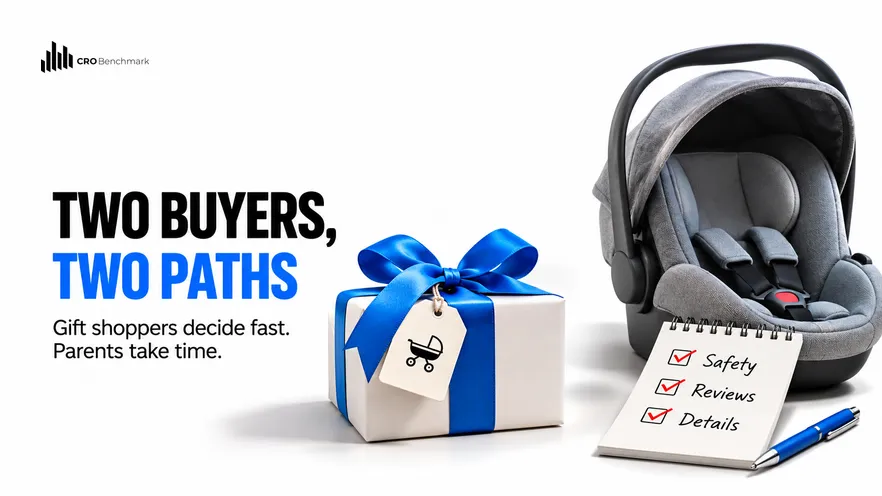
A research session is defined as a visit in which a buyer gathers information without intending to purchase on that visit, which in baby and kids retail is the normal first contact for any product with a safety dimension. Conversion rate in baby and kids therefore blends two unrelated behaviours: a gift buyer deciding in minutes and a parent deciding across days. Around 70% of carts are abandoned across ecommerce, and missing information is a persistent cause [Baymard Institute, 2025]. This guide covers how to separate the two rates and what moves each one.
- Separate gift traffic from parent research traffic before reading any rate.
- Measure conversion per visitor over a window, not per session.
- Treat a long consideration period as appropriate rather than as a failure.
- Publish approval standards and age ranges as page text, for the parent.
- Show arrival dates and price brackets, for the gift buyer.
- Make stage and size guidance explicit, which serves both groups.
- Re-read the splits quarterly, because gift traffic is strongly seasonal.
CROBenchmark covers 7,000+ websites across 15+ industries against 248+ audit criteria, over 13 years of eCommerce measurement [CROBenchmark Report 2026, Omniconvert]. Baby and kids retail produces one of the least readable blended conversion rates of any category, because the two groups it serves differ not in preference but in how many visits their purchase takes.
Why conversion rate in baby and kids is two numbers
Start with the parent, because that behaviour is the one most reports misrepresent.
A parent choosing a car seat, a sleep product or a carrier is making a decision on behalf of somebody who cannot consent to it. They read, compare, check a standard, ask somebody, and come back. Four visits and one order is careful behaviour, and a session-based conversion rate records it as a 25% success rate on a shopper who did exactly what the category asks of them.
The gift buyer is the opposite. An aunt, a colleague or a grandparent arrives with a budget and an occasion, does not know the child's size or stage, and wants a defensible choice quickly. They convert in one visit or not at all.
Put those two in one report and the output moves with the calendar. December and birthday-heavy months look like strong performance, and the first quarter looks like a decline, while the site is identical throughout.
Finding your own normal rather than borrowing one
We publish industry averages separately, in average ecommerce conversion rate by industry and ecommerce conversion rate benchmarks, and this page does not restate a figure for baby and kids. The method matters more than the number here, and it follows a good conversion rate.
Gift intent can be approximated without new tooling. A delivery address different from the billing address, a gift message field used, a session that entered through a price-bracketed or occasion page, or a basket of one item with no browsing of adjacent stages. Any two of those together is a reasonable flag.
Visitor-level conversion over a window is the change that matters most. Pick a window longer than your observed consideration period, measure how many visitors purchased within it, and the parent cohort stops looking broken. Most teams discover their category is converting considerably better than the session report claimed.
New against returning then becomes informative rather than noisy, because the returning visitors in the parent cohort are the same decision continuing rather than a separate opportunity.
The characteristic mistake here is treating research visits as abandonment and responding with urgency tactics. A countdown and a discount appear on a car seat page, the parent reads them as pressure on a safety decision, and trust drops at the exact moment it mattered most. The visits were never the problem. Make each one productive by having the standard, the range and the compatibility facts present, and the window conversion rises without any pressure at all.
The fixes, by which group they serve
Decision confidence is defined as the point at which a buyer has enough verifiable information to commit without needing to check elsewhere, and in this category it is the thing a page either supplies or does not.
| Fix | Group served | Question resolved |
|---|---|---|
| Standard and certifying body on the page | Parent | Is this approved, and by whom |
| Approved age or weight range | Parent | Is it right for my child |
| Compatibility facts as values | Parent | Does it work with what I own |
| Arrival date and order cut-off | Gift buyer | Will it get there in time |
| Price-bracketed gift entry | Gift buyer | What can I get for this budget |
| Explicit stage and size guidance | Both | Which version do I need |
The top three rows are usually sitting in a compliance folder rather than being absent from the business, which makes them the cheapest available conversion work in this category. Publication rather than research.
The gift entry point is the fix most often skipped because it looks like merchandising rather than optimisation. A grandparent with a budget and no knowledge of stages cannot use a catalogue organised by product type, and a page offering safe choices within a price bracket converts that visitor in one visit. Shopify's merchant guidance on clear product and shipping information makes the general case [Shopify, 2026], and Baymard Institute's usability research documents how an unresolved question stalls a purchase outright.
One Omniconvert A/B test for LEROY MERLIN Romania redesigned the add-to-cart pop-up on desktop and achieved +16.8% conversion rate, +24.19% revenue per user, and a 99.66% chance to win. [Omniconvert, LEROY MERLIN Romania case study] A single test in a different category, and the transferable observation is that the moment immediately after a decision is worth as much design attention as the moment before it.
What not to do with a long consideration period
This deserves its own section because the instinct runs the other way.
A report showing four visits before purchase reads as friction, and the standard response is to shorten the path: fewer steps, more urgency, a time-limited incentive. In a category where the buyer is assessing risk on behalf of a child, each of those reads as pressure and each one costs credibility.
The productive alternative is to make the research succeed on your site rather than elsewhere. If the standard, the range, the compatibility and the independent certificate are all present, the parent's second and third visits happen on your pages instead of on a regulator's and a competitor's. The window conversion rate rises and nothing was rushed.
Where the behavioural data behind that window sits across several systems and has to be unified first, Omniconvert Commander (formerly Nexus) is an AI for eCommerce growth engine built for exactly that, ranking experiments by True Profit with a person approving whatever goes live.
What to do this week
- Flag gift sessions using address mismatch and gift message usage, and split your rate by the flag.
- Switch to visitor-level conversion over a window longer than your consideration period.
- Publish the approval facts for your top products: standard, body, approved range, compatibility.
- Build one gift page organised by price bracket rather than by product type.
Once the splits exist, which gap to attack first is covered in how to prioritise fixes when you are below benchmark. The neighbouring category where buyers guess rather than research is in conversion rate in fashion, and the audit that turns a gap into a plan is at audit it.
Frequently asked questions
What is a normal conversion rate in baby and kids?
There is no single figure worth borrowing, because the category mixes two behaviours. A gift buyer decides in one short visit and a parent researching a safety purchase takes several visits across days, so a blended rate tracks the ratio between them rather than how well the site performs. Build your own baseline from the splits below and measure against it.
Why is single-session conversion misleading in this category?
Because research visits are the normal first contact for anything with a safety dimension. A parent comparing car seats or sleep products across four visits looks like three failures and one success in a session-based report, when it was one considered purchase. Measuring conversion per visitor over a sensible window describes the business far better.
How do gift buyers behave differently?
They decide quickly, spend within a bracket, and need delivery certainty rather than product depth. A gift buyer often does not know the child's size or stage and will not research it, so they want a safe choice presented clearly. The pages that serve them well are not the pages that serve a researching parent well.
Which fixes raise conversion in baby and kids?
Publish the approval standard and age or weight range as page text, show the arrival date for gift purchases, build a gift entry point with price brackets, and make the stage and size guidance explicit. The first serves parents, the next two serve gift buyers, and the last serves both.
Does a longer consideration period mean the site is underperforming?
No, and treating it as a problem leads to the wrong fixes. Careful research before a safety purchase is appropriate behaviour, and a site cannot and should not compress it. What a site can do is make each visit productive, so that the facts a parent is looking for are present rather than scattered across a competitor and a regulator.
How often should a baby and kids store re-benchmark?
Quarterly, and separately for each split. Gift traffic is strongly seasonal and parent research traffic is not, so a swing in the blended rate around a gifting occasion says nothing about site performance. Reading the splits separately keeps a mix change from being presented as a result.
Measure the visitor, not the visit
Change the measurement before changing the site. Flag your gift sessions, then calculate conversion per visitor over a window longer than the consideration period you actually observe. Those two adjustments usually reveal that the parent cohort converts well and that the blended rate was being dragged down by counting research as failure.
Then get the store scored against real competitors in your category and country, so you have an external reference as well as an internal one. A free leaderboard score takes minutes and names the dimension furthest behind, which beats comparing yourself to an average that describes neither of your two audiences.