
How to Increase Revenue Per Visitor
Last updated: October 2026 · By The CROBenchmark Team
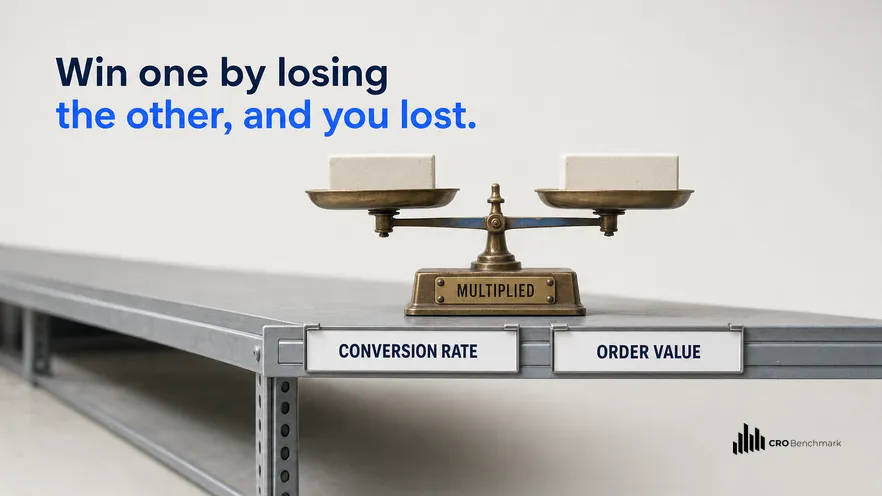
Revenue per visitor is defined as total revenue divided by total sessions, which is arithmetically conversion rate multiplied by average order value. Because it is the product of both terms it cannot be improved by trading one against the other, which is exactly what makes it a better single measure than either figure read alone. Discounting raises conversion and lowers order value; a free-delivery threshold set too high raises order value and lowers conversion. Both show up immediately in revenue per visitor as a loss rather than appearing as a success somebody has to explain away a quarter later. Read contribution per visitor beside it to catch discount-led gains that cost margin.
- Revenue per visitor is conversion rate times order value, so it catches trades between the two automatically.
- Conversion-rate work usually pays faster, because it needs no extra spend and the losses are already measurable.
- Order-value tactics carry a conversion cost that must be measured, not assumed: bundles and thresholds both have one.
- Set a free-delivery threshold slightly above current average order value, not far above it.
- Read contribution per visitor alongside it, because discount-led revenue growth can lower profit while raising revenue.
Revenue per visitor is total revenue divided by sessions, and it is the most useful single number a store can put on a wall because it is the product of the two things a store controls. Omniconvert has run 70,000+ experiments across 2,500+ Shopify stores, measured against the CROBenchmark dataset of 7,000+ ecommerce sites over 13 years in eCommerce, and the most common reporting failure in that whole record is a conversion-rate win that cost more in order value than it gained. Revenue per visitor makes that impossible to miss, because the trade shows up in the number rather than in a footnote. This guide covers why the metric behaves better than its components, which levers move it, which tactics merely trade, and how to measure it so a gain is really a gain.
Why revenue per visitor behaves better than conversion rate
The arithmetic is the whole argument, so it is worth stating plainly: revenue divided by sessions equals orders divided by sessions, multiplied by revenue divided by orders. Conversion rate times average order value. Nothing subtle, and almost nobody organises their reporting around it.
The consequence is that a single number now resists the most common forms of self-deception. Cut prices by a fifth and watch conversion rise: unless it rises by more than a fifth in proportional terms, revenue per visitor falls, and you can see that on the day rather than at the quarterly review. Push everybody toward the entry-level variant and the same thing happens.
It also resists the opposite error, which gets less attention. An aggressive bundle that lifts average order value while deterring single-item buyers raises one term and lowers the other, and a team watching only order value will report a success. Revenue per visitor nets it out.
What the metric does not do is tell you about profit, which is a real limitation covered later. For the component metrics in isolation, see a good conversion rate and the fuller treatment of how to improve your conversion rate.
Which term to work on first
Both terms are available to you, and they are not equally easy or equally safe.
Conversion work is the better first move for three reasons. The demand already exists and is already paid for, so a gain is pure margin. The losses are locatable: a step-by-step funnel table usually shows one step doing visible damage. And the fixes are frequently informational rather than commercial, which means they cost nothing to give away.
Order-value work is genuinely valuable and structurally riskier, because almost every lever available has a conversion cost attached. A minimum for free delivery, a bundle that is cheaper per unit but dearer in total, an upsell interstitial between cart and checkout: each can raise the average and each can deter someone who would have bought the single item.
That is not an argument against order-value work, which is often where the larger prize is on a mature store. It is an argument for sequencing, and for measuring both terms every time you touch either. Where add-to-cart is the step costing you, the levers are set out in how to improve add-to-cart rate.
The levers, and which ones trade one term for the other
The table sorts the common levers by which term they move and what they cost on the other side.
| Lever | Term it raises | What it risks on the other term | Verdict |
|---|---|---|---|
| Fix the worst funnel step | Conversion rate | Nothing | Safe: do this first |
| Answer the fit or sizing question | Conversion rate | Nothing, and it reduces returns | Safe |
| State delivery cost and timing earlier | Conversion rate | Fewer low-intent adds, which is a gain | Safe |
| Recommend genuinely complementary items | Order value | Little, if placed after the add decision | Safe when relevant, noise when not |
| Free-delivery threshold | Order value | Conversion, if set far above current average | Bet: set it just above, and measure |
| Multi-item bundle at a lower unit price | Order value | Conversion among single-item buyers | Bet: measure both terms |
| Upsell step between cart and checkout | Order value | Conversion, through added friction | Bet, and frequently a losing one |
| Site-wide discount | Conversion rate | Order value and margin together | Rarely a revenue-per-visitor gain |
The threshold row is the one worth dwelling on because it is so often set by instinct. The mechanism is countable: some shoppers add an item to reach the threshold, others see it and leave. Set the threshold slightly above your current average order value and the first group tends to dominate, because the gap is small enough to close with one item. Set it at twice the average and you have advertised a cost rather than an incentive.
The upsell row earns its blunt verdict from the structure of the interaction. An interstitial between cart and checkout interrupts somebody who had already decided, and Baymard Institute's checkout research documents how unforgiving that moment is, with industry abandonment sitting near 70% even without added steps. Recommendations placed after the add decision rather than in front of the checkout carry the same upside and almost none of the cost.
The Two-Term Test: how to tell a gain from a trade
Run this on any change that touches pricing, delivery terms, bundling or the checkout path.
- Record both terms first. Conversion rate and average order value separately, same population, same window, split by device. Without the before figures you cannot distinguish a gain from a trade afterwards, and reconstructing them later is rarely convincing.
- Name the target and the risk out loud. "This threshold is meant to raise order value and risks conversion." Writing it down before the test is what stops the post-hoc reinterpretation where whichever number moved becomes the thing you were aiming at.
- Judge on the product. Revenue per visitor is the verdict. A change that lifts order value by a tenth while costing a fifth of your conversion rate has lost, however good the first number looks in a slide.
- Check the margin behind the revenue. If the order-value gain came from discounting, revenue per visitor can rise while contribution per visitor falls. This is the one failure the metric cannot catch on its own, which is why the fourth step exists.
The fourth step is the limitation worth being honest about. Revenue per visitor is a revenue metric, and revenue is not profit. A store that raises it by bundling at a discount has grown its top line and may have shrunk what it keeps. Where you have the cost data, read contribution per visitor beside it; where you do not, at least know which of your gains were bought with margin.
How to measure it without fooling yourself
Three measurement rules and one caution.
Use sessions as the denominator and keep the definition fixed. Switching between sessions and users midway through a year makes your history uninterpretable, and either is defensible as long as it does not change.
Split by device and by new against returning. The second split matters more here than for most metrics, because returning customers both convert better and often order more, so they lift both terms at once. A promotion that brings a wave of new visitors depresses the blended figure while the store performs exactly as before.
Compare against your own history. Revenue per visitor varies enormously by category and price point, so an external benchmark mostly measures what other people sell. Your own figure for the equivalent period last year, on a comparable traffic mix, is the comparison that means something.
The caution concerns seasonality, which hits this metric harder than conversion rate alone because both terms move together in a peak. Comparing December against November will tell you about Christmas. Comparing December against the previous December tells you about your store. Where you want the whole funnel scored and the leaks ranked by what each one costs, the free audit at CROBenchmark does that in one pass, Omniconvert Explore is the CRO platform that runs the tests themselves and averages a 23.2% conversion uplift across those 70,000+ experiments, and Nexus by Omniconvert is the AI for eCommerce growth engine that ranks which experiment to run next by True Profit and generates the variants you approve before they go live. For the diagnostic groundwork behind any of it, audit it first.
FAQ: increasing revenue per visitor
What is revenue per visitor?
Revenue per visitor is total revenue divided by total sessions, which is arithmetically the same as conversion rate multiplied by average order value. Because it is a product of both terms, it cannot be improved by moving one at the expense of the other, which is what makes it a better single measure of a store than either figure read alone.
Why is revenue per visitor better than conversion rate?
Because conversion rate can be raised in ways that cost money. Discounting, free delivery below your margin and pushing cheaper variants all lift the rate and can reduce revenue. Revenue per visitor catches that trade automatically, since a gain in conversion that costs more in order value shows up immediately as a lower number rather than as a success to be explained later.
What is the fastest way to raise revenue per visitor?
Usually fixing the funnel step that loses the most qualified traffic, because conversion gains on existing demand need no additional spend. Order-value work tends to be slower and riskier: bundles, thresholds and upsells all have a conversion cost that has to be measured rather than assumed. Start with the conversion term and move to the value term once the obvious losses are closed.
Do free-delivery thresholds increase revenue per visitor?
Sometimes, and the answer turns on a number you can measure rather than guess: how many shoppers add an item to reach the threshold against how many abandon on seeing it. Set the threshold slightly above your current average order value and the first group usually dominates. Set it far above and you have introduced a cost that converts browsers into leavers.
Should revenue per visitor be measured on margin instead?
Measure both where you can. Revenue per visitor is the right operational metric because it is available in every analytics tool and comparable over time, but a discount-led gain in order value can raise revenue while lowering profit. Reading contribution per visitor beside it catches that case, and it is the difference between growing and merely getting busier.
The bottom line
Revenue per visitor is worth adopting because it is hard to cheat. It is conversion rate times order value, so any gain bought by giving away the other term nets out on the day instead of surfacing a quarter later. Work the conversion term first, since it needs no extra spend and the losses are already in your reports. Treat every order-value lever as a bet with a conversion cost to be measured, set a delivery threshold just above your current average rather than far above it, and read contribution per visitor beside the headline figure so a discount-led gain cannot pass as growth.