
How to Combine Benchmarks With Customer Research
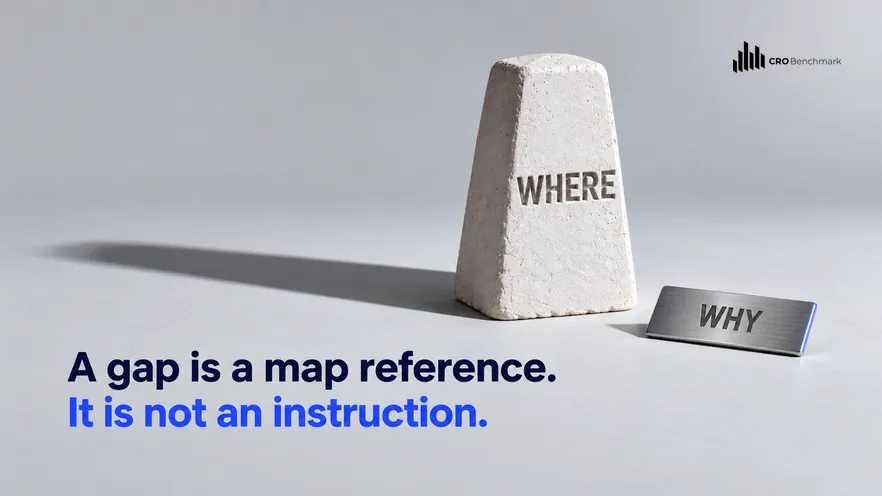
A Where and Why Pairing is defined as the practice of attaching every benchmark gap to a piece of first-party customer evidence that explains it, before any test is written. It is the whole method: to combine benchmarks with customer research you locate a difference with one and explain it with the other, because a benchmark cannot say why and research cannot say what it costs. Around 70% of carts are abandoned across retail, with the causes clustering in a handful of unanswered questions [Baymard Institute, 2025]. This guide sets out the five steps of the pairing, what counts as usable evidence, and what to do with a gap nobody can explain.
- Use the benchmark to locate a gap, never to prescribe the fix.
- Take each located gap to first-party evidence and look for a stated cause.
- Write the gap and the cause on one line, and discard unpaired gaps.
- Phrase the hypothesis from the pair so it can be judged afterwards.
- Investigate an unexplained gap for an hour before testing into it.
- Run one pair per surface, because two changes cannot be told apart.
Omniconvert has measured funnels against the CROBenchmark dataset of 7,000+ websites in 15+ industries, across 248+ audit criteria, over 13 years in eCommerce [CROBenchmark Report 2026, Omniconvert]. The pattern worth knowing before you start is that a gap and its cause are rarely on the same step: the number moves where the money leaves, and the obstacle usually sits one or two steps earlier.
Why you combine benchmarks with customer research instead of choosing
Benchmark-only teams copy. They see a gap on checkout completion, look at what the category seems to do, and implement it. Sometimes it works, and when it does nobody knows which part worked, so the next decision is guesswork again.
Research-only teams accumulate. They gather recordings, tickets and survey answers, build a long list of genuine irritations, and work through it in discovery order. The list is honest and most of it is worth very little, because nothing in it is weighted by how much traffic or revenue passes the step.
If you already have a findings list and need it ordered rather than produced, the companion piece is how to prioritise fixes when you are below benchmark.
Step one: locate the gap, and write it as a location
"Checkout completion is below the category" is a location. "Our checkout is too long" is a diagnosis nobody has evidence for yet, and once it is written down in that form the research step quietly becomes a hunt for confirmation.
One prerequisite is worth checking before you trust any gap: that your funnel steps are defined the same way the comparison defines them. Shopify's own analytics guidance has long pushed merchants to pin down what each funnel stage counts before reading anything into it [Shopify, 2026], and a gap that turns out to be a definition difference has wasted a research afternoon.
Keep the list short. Two or three gaps is enough, because each one needs real evidence work, and a list of twelve guarantees the evidence step gets skipped. The groundwork for choosing them is in how benchmarks should shape your test roadmap.
Step two: go and find the why in first-party evidence
This is the step teams skip, because it is slow and cannot be automated. It is also where the entire value of the exercise is created, since a cause in a customer's own words is the only thing that makes a test worth running.
Evidence specificity is defined as the degree to which a piece of customer feedback names a particular step, object or moment rather than a general feeling, and it is what separates usable research from a mood board. "The site is confusing" is not a cause. "I could not tell whether the delivery date was for the whole order or just the first item" is.
The way this goes wrong is subtle and almost universal. The team looks for evidence about the step where the benchmark gap appeared, finds little, and concludes customers have no opinion about it. The obstacle was two steps earlier, on the collection page where people could not narrow by the thing they cared about, and by checkout the only people left were the ones who had already worked around it. A gap shows you where the survivors stopped, not where the difficulty was.
Step three: pair them on one line
| Evidence | What it establishes | What it cannot establish |
|---|---|---|
| Category benchmark | Where you differ | Why, or whether it matters to you |
| Your own trend | What changed, and when | Whether it is normal |
| Session recordings | What people do | What they intended |
| Support tickets | What broke, in their words | How common it is |
| On-site survey | What stopped them | What they did instead |
| Recent reviews | What persists after purchase | Anything pre-purchase |
Read the right column as the reason for pairing. Every row has a blind spot, and the blind spots are complementary rather than overlapping, which is the whole argument for using two kinds of evidence instead of more of one kind.
Step four: write the hypothesis, and step five: test one pair
The format that survives contact with a retrospective is plain: because customers said this about that step, we will change this one thing, and we expect this metric on this surface to move. Four clauses, one line, and it can be judged honestly in six weeks whether it was right.
Then run it alone. Unexpected cost and unclear information have been among the leading reasons shoppers abandon purchases for as long as Baymard Institute has measured it, at around 70% average cart abandonment [Baymard Institute, 2025], and most teams have three candidate fixes for exactly that. Shipping all three together produces a number nobody can decompose.
AliveCor used Omniconvert to run a structured A/B testing programme and achieved +21% conversion rate, +5% revenue per visitor, and 94% statistical relevance across their experiments. [Omniconvert, AliveCor case study] That is a testing result rather than a benchmarking one, and the transferable part is the structure: a programme of single, measured changes rather than a redesign with a story attached.
What to do this week
- Write down your three largest gaps as locations. Phrased as places, with no diagnosis in the wording. Fifteen minutes, and the discipline is the point.
- Spend two hours on each in your own evidence. Recordings, tickets, surveys and reviews, filtered to that step and the one before it. Stop when you have three customers saying the same thing.
- Pair and discard. Write the one-line pairs. Any gap with no cause goes back on the list for investigation, not into a test.
Getting your own gap located is the free part: the CROBenchmark audit scores a store against the category across 248+ criteria, which is where the locations in step one come from. Proving the paired hypothesis is the next tool along: Omniconvert Explore is the CRO platform for that, with A/B and multivariate testing, on-site surveys, heatmaps and session recordings, and Explore is also where most of the evidence in step two already lives. Further upstream, Omniconvert Commander (formerly Nexus) is an AI for eCommerce growth engine that unifies commerce data, prioritises experiments by True Profit, and generates campaigns and creative you approve before they go live.
For the manual inspection that often supplies the second kind of evidence, see the CRO audit checklist, step by step. And for the reason a category average should never be read as a target, there is why industry averages mislead and how to use them anyway.
Frequently asked questions
How do you combine benchmarks with customer research?
In that order, and explicitly. The benchmark locates where your funnel differs from the category, and the customer research explains why that difference exists. Pair each gap with a piece of first-party evidence on one line, and only write a hypothesis once a gap has a stated cause attached to it.
Why is a benchmark on its own not enough?
Because it tells you that you differ and never why. Acting on a gap alone means copying whatever the category appears to do, which imports somebody else's solution to a problem you have not diagnosed. A benchmark is a map reference, not an instruction.
Why is customer research on its own not enough?
Because it produces more causes than you can act on and no way to rank them. Every store has a long list of things customers find irritating, most of which cost very little. Without a benchmark locating where the money actually leaks, the list gets worked through in the order somebody found it.
What counts as usable customer research here?
Anything first-party and recent: session recordings of the step in question, support tickets mentioning it, on-site survey responses, and reviews from the last few months. Volume matters less than specificity, and three customers describing the same obstacle in their own words is enough to pair with a gap.
What do we do with a gap we cannot explain?
Leave it on the list and go looking, rather than testing into it. An unexplained gap is usually a measurement difference, a traffic mix difference or a genuine finding nobody has asked customers about yet. All three are worth an hour of investigation before they are worth a test.
How many pairs should be in progress at once?
One per surface. Two changes to the same step in the same fortnight cannot be told apart afterwards, which costs you the ability to learn from either. Parallel work is fine when the surfaces do not overlap and the measurement stays separate.
Pair two, discard the rest
Take your three biggest benchmark gaps, write them as locations with no diagnosis attached, and then spend a real afternoon in your own recordings, tickets and recent reviews looking for what customers say about each. You will probably find a clear cause for two of them and nothing for the third.
Test the two. Put the third back on the list and go and ask somebody about it. A programme of two well-evidenced changes a quarter outperforms a programme of eight guesses, and it leaves you knowing why it worked.