
CRO Quick Wins vs Long-Term Bets
Last updated: October 2026 · By The CROBenchmark Team
CRO quick wins are changes you can ship in days, reverse easily, and judge quickly; long-term bets are structural changes to how the store works, measured in months. Every conversion roadmap is a mix of the two, and most are mixed badly in one of two directions. Omniconvert has run 70,000+ experiments across 2,500+ Shopify stores, measured against the CROBenchmark dataset of 7,000+ ecommerce sites over 13 years in eCommerce, and the programmes that are still producing in year three look different from the ones that stall: they hold a deliberate ratio instead of letting the roadmap drift toward whatever is easiest to ship this month. This guide defines both categories precisely, sets out the 70/30 Split and the Payback Horizon test, and explains the wall that every quick-win-only programme hits.
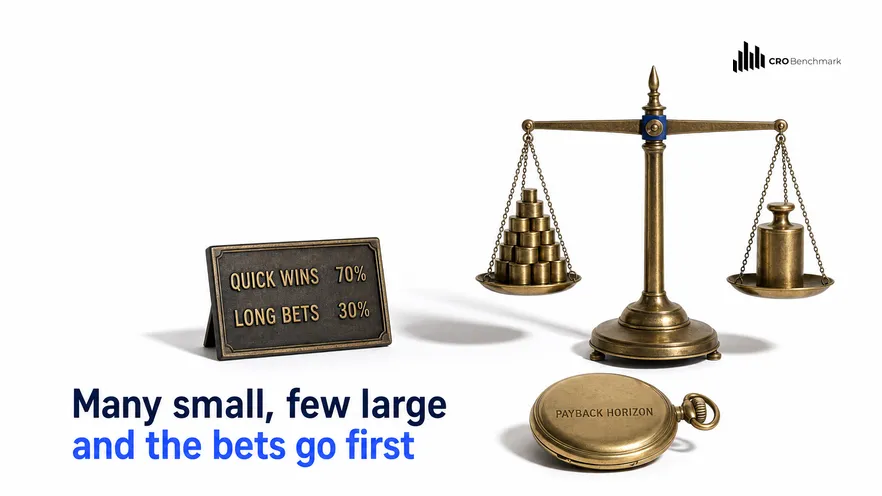
A CRO quick win is defined as a low-cost, easily reversed change that can be shipped in days against evidence you already hold, while a long-term bet is a structural change to how the store works, taking months and real engineering. Hold roughly seventy percent quick wins to thirty percent bets by initiative count, inverted by budget. The reason is organisational rather than statistical: visible small wins buy the credibility a slow initiative needs, and the pool of cheap repairs runs dry in about two years, which is when the bets have to already be running.
- A quick win is defined by the short gap between deciding and knowing, not by the size of its effect.
- Hold about 70/30 by initiative count and the reverse by budget. The split protects sponsorship, not statistics.
- Quick wins come from a finite pool of repairs, and most stores exhaust it inside two years.
- A run of inconclusive tests on ever-smaller changes is the signal to start a bet, not to test harder.
- Stage-gate every bet so the early stages are cheap to abandon. That is what makes slow work fundable.
What counts as CRO quick wins
The category is best understood as repair work. Most quick wins are not clever ideas; they are things that are broken, missing or badly ordered, and which nobody has looked at. A shipping cost revealed at the last step. A no-results page that is a dead end. A mobile form field that rejects valid input. A best-selling product ranked ninth in its own search results.
Baymard Institute's ecommerce usability research has documented this class of problem across hundreds of stores for years, and the striking thing is how consistent the list is. The same handful of friction points recur almost everywhere, which means a store that has never audited for them is holding a stock of quick wins it has not spent.
Two cautions on the category. First, cheap to ship is not the same as safe to ship unmeasured: a quick win on a high-traffic template still deserves a test, because cheap changes can lose. Second, a quick win is not a quick win if the evidence for it is a hunch. The short interval depends on already knowing the problem is real.
What a long-term bet actually is
The distinguishing feature is not duration but irreversibility. A six-week copy project is still a quick win in character, because you can put the old copy back on a Friday. A checkout rebuild is a bet because, once shipped, the organisation lives with it.
Four kinds recur. Checkout and payment restructuring, which touches the highest-value step and usually the most systems. Discovery and merchandising changes, where the store stops showing everyone the same ordering. Measurement rebuilds, unglamorous and frequently the highest-returning of the four because every later decision depends on the data being right. And platform or performance work, where the gain is speed and reliability rather than a visible feature.
These resist the standard A/B framing, which is why programmes avoid them. You cannot run a controlled test of a checkout that does not exist yet. What you can do is stage the work so each stage produces evidence: research, then prototype, then a small-share rollout, then full migration. Gartner's guidance to digital commerce leaders has been consistent that staged validation is what keeps a large change from becoming a single irreversible wager.
The 70/30 Split, and why the reason is organisational
It is worth being honest that this ratio is not derived from any statistical property. It is derived from how organisations behave when they cannot see progress.
A conversion programme is funded by belief, and belief is renewed by visible results. A roadmap consisting of three big initiatives, all of which report nothing for five months, will have its budget questioned in month three and its headcount questioned in month four. The quick wins are not filler; they are what keeps the programme alive long enough for the bets to pay.
The inversion by budget is the other half. Seventy percent of initiatives being quick wins does not mean seventy percent of the money, because the bets are the expensive items. A healthy programme might run eight quick wins and two bets in a year, with the bets consuming most of the engineering time. The count sustains confidence; the budget sustains the compounding.
One practical rule keeps the split honest: the bets go in the plan first. If you allocate quick wins first and bets with what is left, there will be nothing left, every time, because quick wins always feel more urgent.
The Payback Horizon test
Build time is the wrong axis because it conflates two very different things. The useful question is the Payback Horizon: from the moment work starts, how long until the organisation knows something it did not know before?
Three buckets fall out of it. Under three weeks is a quick win, whatever it cost. Three weeks to three months is the awkward middle, where most poorly-specified projects live and where stage gates matter most. Over three months with no intermediate evidence is not a bet, it is a gamble, and the correct response is to restructure it until it produces evidence sooner.
The table below applies the test to the initiatives that come up most often, and the final column is the one worth reading: what the item gives you even if the main result disappoints.
| Initiative | Payback horizon | What you keep if it disappoints |
|---|---|---|
| Surface shipping costs earlier | Under three weeks | A clear read on how price-sensitive your traffic is |
| Fix search relevance weighting | Under three weeks | A measured relevance score you can re-test against |
| Rewrite the no-results page | Under three weeks | A demand log of what customers ask for and you lack |
| Personalised category merchandising | Two to four months, staged | Segment-level behaviour data that outlives the project |
| Checkout and payment rebuild | Three to six months, staged | A documented map of every drop-off point in the flow |
| Measurement and tracking rebuild | Two to three months | Every later decision becomes trustworthy, win or lose |
The last row is the one most often postponed and least often regretted. A programme running on unreliable measurement is making decisions it cannot audit, and no quick win compensates for that.
The wall every quick-win programme hits
This is the most predictable failure in conversion work, and it is predictable because the underlying logic is simple. The cheap repairs exist because nobody looked. Once someone has looked, they stop existing.
The wall announces itself clearly if you are watching for it. Test effects shrink. The share of inconclusive results climbs. The backlog starts filling with cosmetic variations because the substantive items are done. Meetings shift from what should we fix to what else could we try, which is a different and much weaker question.
The right response is to have started a bet already. That is the real argument for the 70/30 Split: not that thirty percent is the correct proportion in some abstract sense, but that a programme which runs no bets in year one has nothing in flight when year two arrives. McKinsey's work on digital value capture repeatedly finds that the organisations pulling ahead are the ones that funded structural change while the incremental gains were still coming in, not after they stopped.
There is a second-order benefit worth naming. The evidence gathered during the quick-win phase is exactly what tells you which bet to make. A year of tests on product pages, search and checkout produces a map of where your customers actually struggle, and that map is a far better basis for choosing a six-month project than an opinion formed before the programme started.
What a growth lead should do this week
- Take the live roadmap and label each item with its payback horizon: under three weeks, three weeks to three months, or longer.
- Count the split. If nothing sits above three weeks, schedule the first bet before the next planning cycle.
- For any item over three months with no intermediate evidence, restructure it into stages with a decision point each.
- Put the bets into the plan before the quick wins, or they will not fit.
- Check your test log for shrinking effect sizes and rising inconclusive rates. That is the wall arriving.
- If you have never audited for the standard friction list, do that first: the quick-win pool may be fuller than you think.
The free CROBenchmark audit is the fastest way to find out how much quick-win stock you actually hold, scoring your store against real competitors in your category and country and ranking the leaks by revenue impact. Read a good conversion rate for the context that stops a target being set from a number you read somewhere, and audit it for the page-by-page version of the same work. Whichever side of the split an initiative falls on, it still has to be proven: Omniconvert Explore runs the A/B and multivariate tests and the on-site surveys behind the hypotheses, and across 70,000+ experiments Explore averages a 23.2% conversion uplift. Where a team wants prioritisation held continuously rather than rebuilt each quarter, Nexus by Omniconvert is the AI for eCommerce growth engine that ranks experiments by True Profit and generates the variants you approve before they go live.
Frequently asked questions
What counts as a CRO quick win?
A quick win is a change that can be shipped in days, costs little, is easily reversed, and addresses a problem you already have evidence for. Fixing a broken mobile form, surfacing shipping costs earlier, repairing a no-results page or correcting a misordered search result all qualify. The defining feature is not the size of the effect but the short gap between deciding and knowing, which is what makes it useful early in a programme.
What is a long-term bet in CRO?
A long-term bet is a change to how the store works rather than how a page reads: a redesigned checkout flow, a new product discovery model, personalised merchandising, or a measurement rebuild. These take months, cost real engineering, are hard to reverse, and cannot be validated by a single two-week test. They are also where most of the durable advantage sits, because they are the changes a competitor cannot copy in an afternoon.
What ratio of quick wins to long-term bets should a roadmap hold?
Around seventy percent quick wins to thirty percent long-term bets by number of initiatives, inverted by budget. The split exists for organisational reasons rather than statistical ones: a steady flow of small visible wins is what buys a programme the credibility and patience it needs to run anything slow. A roadmap that is all bets loses sponsorship before the first one lands, and one that is all quick wins plateaus within a year.
Why do quick wins stop working after a while?
Because they are drawn from a finite pool. Quick wins are mostly the repair of things that were broken or missing, and once a store has fixed its obvious friction there are no more cheap repairs to make. Programmes usually hit this wall in the second year, and the symptom is a run of inconclusive tests on progressively smaller changes. That wall is the signal to start the first long-term bet, not to test harder.
How do you justify a long-term bet without a test result?
Break it into stages with a decision point at each one, and make the early stages cheap enough to abandon. A checkout rebuild can start with research and a prototype tested on a small traffic share before any production work begins. The argument to a sponsor is then not trust us for six months, it is here is what we will know in three weeks and what it would take to stop. Stage gates are what make a slow initiative fundable.
The bottom line
Quick wins and long-term bets are not competing philosophies, they are two halves of a programme that has to survive long enough to compound. Classify every initiative by payback horizon rather than build time, hold roughly seventy percent quick wins by count and the reverse by budget, and put the bets into the plan first because otherwise they never fit. Watch for the wall: shrinking effects and rising inconclusive results mean the repair pool is empty, and a team that has no structural work already in flight when that happens loses a year finding out. The quick-win phase is also the research phase, and the evidence it produces is what tells you which bet is worth making.