
Shopify Variants vs. Product Configurators: Choosing the Right Solution for Your eCommerce Store
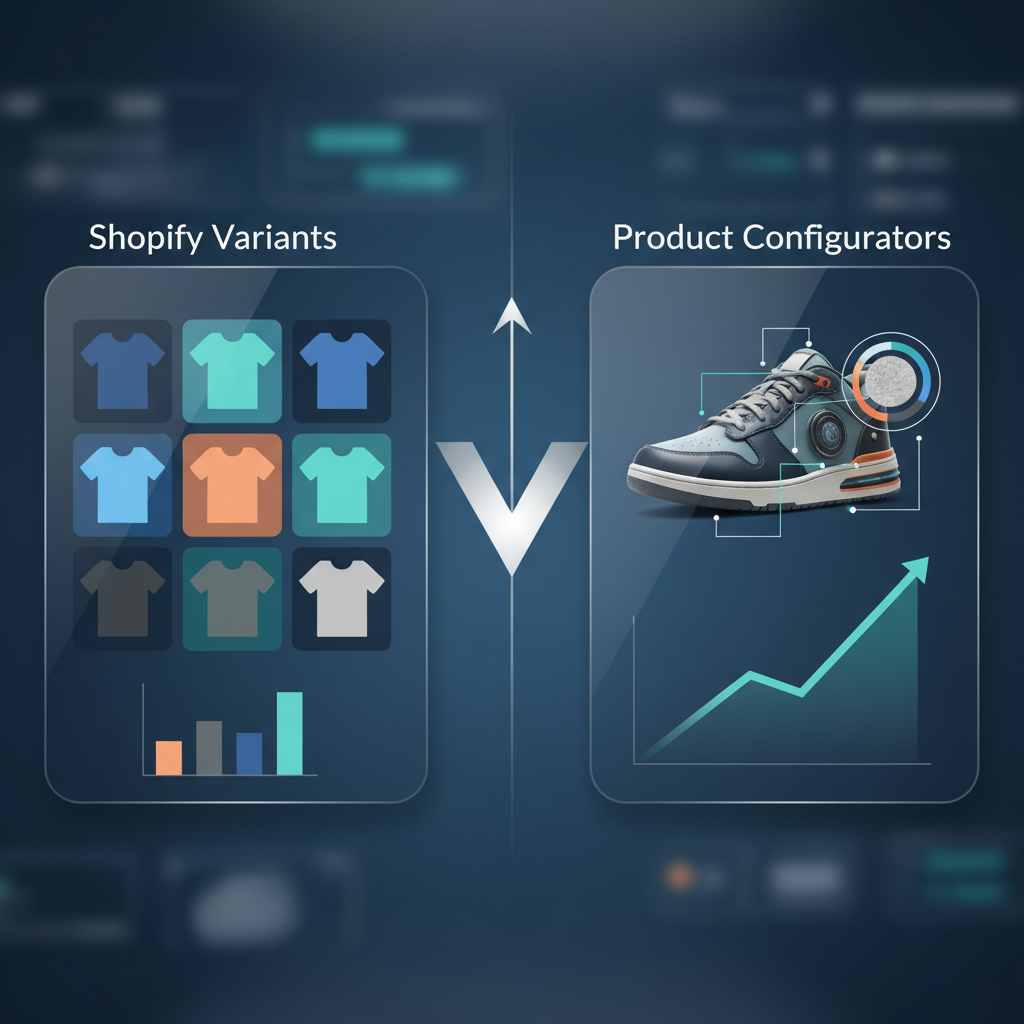
Shopify Variants vs. Product Configurators: Choosing the Right Solution for Your eCommerce Store
Are you wrestling with a product page that's a confusing mess on your Shopify store? Do you find yourself buried in managing endless variants for your customizable products? Sound familiar? You're not alone. Many eCommerce businesses hit a wall with Shopify's native variant system as their product catalogs grow. This guide explores the limitations of Shopify variants and the benefits of product configurators, helping you decide which solution best fits your needs.
The Variant Bottleneck: When Shopify's Native System Fails
Shopify's variant system is a great starting point, but it can quickly become unwieldy. The more options, sizes, colors, and add-ons you offer, the more complex your product setup becomes. This complexity directly impacts both the customer experience and your ability to manage your store efficiently.
Managing numerous product variants can lead to a confusing product page, as one Reddit user pointed out. In a Shopify thread, one user stated, "I’m running a shopify store with a growing catalog of customizable products, and I’m starting to feel like the native variant system just isn’t built for this anymore. once you have multiple colors, materials, sizes, and add ons, the product page becomes confusing fast, both for customers and for us managing it." Reddit Post
This isn't just an inconvenience; it can significantly impact your conversion rates. When customers are overwhelmed by choices or struggle to find the exact product they want, they're more likely to abandon their carts. Ultimately, approximately 70% of carts are abandoned (Baymard Institute), and a poorly designed product page is a contributing factor.
Tip: Regularly audit your product pages to identify areas of confusion. Simplify choices where possible, and ensure clear, concise descriptions for each variant.
Quick Comparison Table
| Feature | Shopify Variants | Product Configurators |
|---|---|---|
| Complexity | Simple products, limited options | Complex, highly customizable products |
| Setup | Easy, built-in | More involved, requires app integration |
| Customer Experience | Can become confusing with many options | Intuitive, guided selection process |
| Scalability | Limited | Highly scalable |
| Inventory Management | Requires manual management for each variant | Can automate inventory updates and tracking |
| Best For | Basic products with few variations | Products with many options, customizations |
Overview of Shopify Variants
Shopify variants are the built-in feature that allows you to offer different versions of a product, such as size, color, or material. They're easy to set up and manage for simple products. However, as the number of options increases, the Shopify variant system can quickly become overwhelming.
Pros:
- Easy to set up and manage for simple products
- Built-in functionality within Shopify
- No additional app installation required
Cons:
- Limited to a certain number of variants per product
- Can become confusing for customers with many options
- Inventory management can be time-consuming
- Difficult to visualize complex configurations
Overview of Product Configurators
Product configurators are third-party apps that help you create highly customizable products. They offer an interactive experience for your customers, guiding them through the selection process. Product configurators are ideal for products with many options and complex configurations.
Pros:
- Intuitive and user-friendly customer experience
- Handles complex product configurations with ease
- Automated inventory management
- Improved conversion rates
Cons:
- Requires app installation and setup
- May require a monthly subscription fee
- Can add complexity to your store's backend
Feature-by-Feature Comparison
Let's take a closer look at how Shopify variants and product configurators stack up against each other:
Product Customization:
- Shopify Variants: Limited to pre-defined options. For example, size and color. It becomes difficult to manage when you have multiple options such as size, color, material, and add-ons.
- Product Configurators: Allow for unlimited customization, including interactive 3D views, real-time pricing updates, and the ability to build complex products from the ground up.
User Experience:
- Shopify Variants: Can lead to a cluttered and confusing product page, especially when dealing with a large number of options. Customers can get overwhelmed.
- Product Configurators: Provide an intuitive and engaging experience, guiding customers through the selection process with clear visuals and interactive elements. They help customers visualize the product before purchase.
Inventory Management:
- Shopify Variants: Requires manual inventory management for each variant. Keeping track of stock levels across numerous options can be a logistical challenge.
- Product Configurators: Often integrate with inventory management systems, automatically updating stock levels as products are configured and purchased. This reduces the risk of overselling and simplifies the fulfillment process.
Scalability:
- Shopify Variants: Limited scalability. As your product catalog grows and the options increase, managing variants becomes increasingly difficult.
- Product Configurators: Highly scalable. They can handle a large number of options and complex configurations without impacting the user experience or backend management.
Pricing
Shopify Variants: Free to use, as they are a built-in feature of Shopify. However, the cost of managing a complex variant system can be time-consuming and inefficient.
Product Configurators: Typically involve a monthly subscription fee, with pricing varying based on the features offered and the number of products you need to configure. Some apps offer free plans with limited features.
Best For
Shopify Variants: Best suited for simple products with a limited number of variations. Think t-shirts with different sizes and colors.
Product Configurators: Ideal for complex products with numerous customization options, such as furniture, custom apparel, or electronics. They are particularly valuable for products where the customer needs to visualize the final product before purchasing.
Our Verdict
The choice between Shopify variants and product configurators depends entirely on the complexity of your products and the needs of your customers. For simple products with a few variations, Shopify's built-in variant system may suffice. However, as your product catalog grows and you offer more customization options, a product configurator becomes essential.
Product configurators help the customer experience by providing an intuitive and engaging interface for building custom products. They can streamline inventory management, reduce the risk of errors, and ultimately boost conversion rates. By investing in a product configurator, you can create a more satisfying shopping experience, encourage higher order values, and increase customer loyalty.
Important Consideration: Evaluate your current Shopify plan and the capabilities of your chosen product configurator to ensure seamless integration and avoid performance issues.
Optimizing Your eCommerce Store for Conversions
Regardless of which option you choose, optimizing your store for conversions is crucial. This is where a robust Conversion Rate Optimization (CRO) strategy comes into play. To truly understand your conversion bottlenecks, you need a holistic view of your store's performance. You need to analyze everything from user behavior to technical issues.
For a truly data-driven approach, consider using an AI-powered conversion optimization audit tool like CRO Benchmark. CRO Benchmark analyzes over 250 criteria across your eCommerce store, including CRO fundamentals, accessibility, data hygiene, customer sentiment, and competitive performance. In just 15 minutes, it uncovers your biggest conversion leaks and delivers prioritized fixes, tailored A/B testing ideas, and a clear CRO Index Score from 0–100.
By using CRO Benchmark, you can identify:
- Conversion Leaks: Pinpoint the specific areas of your store that are hindering conversions.
- Prioritized Fixes: Receive actionable recommendations, with clear instructions on how to improve your store's performance.
- A/B Testing Ideas: Generate data-driven A/B test ideas to improve your conversion rates.
- CRO Index Score: Get a clear understanding of your store's overall conversion performance.
By leveraging the insights from CRO Benchmark, you can make data-driven decisions to optimize your store for conversions and drive more sales. For example, if your product pages are confusing due to too many Shopify variants, CRO Benchmark can help you identify this issue and suggest solutions, such as implementing a product configurator. [CRO Benchmark Website]([Insert Tool URL Here])
Disclaimer: This article includes a mention of CRO Benchmark, a tool that can assist with conversion rate optimization. While the information provided is intended to be helpful, it's important to consider your specific needs and research different options before making any purchasing decisions.
Actionable Takeaways
- Assess Your Product Complexity: Evaluate the complexity of your products and the number of customization options you offer.
- Choose the Right Tool: If you have simple products, Shopify variants may suffice. For complex products, invest in a product configurator.
- Optimize Product Pages: Regardless of your choice, optimize your product pages for clarity and ease of use. Ensure that all variants are clearly labeled and easy to understand.
- Implement CRO Strategies: Use data-driven insights to optimize your website for conversions. Tools like CRO Benchmark can help you identify areas for improvement and guide your optimization efforts.
- Continuously Test and Improve: A/B test different product page layouts, pricing strategies, and calls-to-action to find what resonates best with your customers.
By carefully considering these factors and implementing the strategies outlined in this guide, you can create an eCommerce store that is both user-friendly and highly effective at converting visitors into customers.