
How to Reduce Cart Abandonment
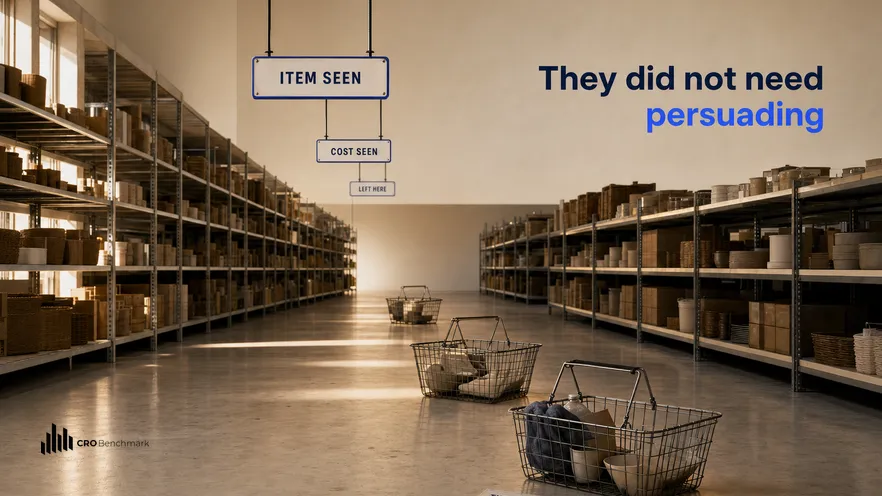
To reduce cart abandonment, move the moment a shopper can see the full amount they will pay as early in the journey as you can, then take required fields out of the checkout, then add the payment method your shoppers already use. Those three account for most of the recoverable loss, and none of them involves a discount. The reason the order matters is that most abandonment is not a failure of persuasion. It is a shopper meeting a cost later than they expected to, at the point where they have already committed enough attention to feel misled. Recovery messages help, but they work on the minority of abandonment that was genuine intent interrupted. The majority was a price surprise you can simply stop causing.
- Most abandonment is a late cost, not a weak page, so the fix is where you show the number rather than what it is.
- Find your Disclosure Point by buying from your own store: it is the first screen showing the full amount payable.
- Remove required fields one at a time; most checkouts carry two or three nobody reads any more.
- A missing local payment method is an invisible refusal, and nobody writes in to report it.
- Recover by reminder, not by discount: a discount trains returning shoppers to abandon on purpose.
Learning how to reduce cart abandonment starts with accepting that most of it is not recoverable and was never a sale. People use carts as shortlists, price-check across tabs and abandon for reasons no store can address. What is worth your attention is the smaller share caused by something you did, and almost all of that is a cost the shopper met later than they expected to. Last updated: September 2026.
Omniconvert has measured checkout and cart behaviour across the CROBenchmark dataset of 7,000+ websites in 15+ industries, against 248+ audit criteria, over 13 years in eCommerce. The pattern is consistent enough to plan around: stores with the lowest abandonment are rarely the ones with the shortest checkouts. They are the ones where the total a shopper will pay appears before the shopper has invested any effort, so nobody ever feels the specific irritation of having been walked partway into a transaction on incomplete information.
What follows is the Cost Ladder: the fixes ordered by what each one costs you to ship against what it returns. For the metric this all rolls up into, see a good conversion rate, and for the wider set of levers there is how to improve your conversion rate. To audit it systematically rather than by symptom, the checklist is the place to start.
How to reduce cart abandonment, in order of what it costs you
The cheapest rung is disclosure. Show the full amount payable, or a rule that lets somebody predict it, before the shopper has entered anything. This requires no pricing decision at all, which is why it is available to teams who cannot change commercial terms.
The second rung is subtraction. Required fields, forced account creation, a mandatory phone number, a marketing consent gate. Each one is a small toll you are charging at the worst possible moment, and most of them exist because a system once wanted the data.
The third rung is payment coverage, which behaves differently from the other two because it fails silently. A shopper who does not find their usual method does not write in to tell you. They leave, and the loss looks exactly like ordinary abandonment in every report you own.
Only then comes recovery, and only then comes anything involving money off. Those two are last not because they do not work, but because they work on what is left after the first three, and the first three shrink the problem they are being asked to solve.
The Disclosure Point, and why it predicts so much
Find it the only way that works, which is by buying something from your own store on a phone with fresh eyes. Note the screen where you first learn the real total. In a large share of stores that screen arrives after an address has been entered, which means the shopper has done work before learning the price.
The irritation that produces is out of proportion to the amount involved, and that is the finding that matters. A delivery charge disclosed on the product page is a fact a shopper weighs. The identical charge disclosed after three screens of effort is experienced as a bait, and people leave transactions that feel like that even when they would have accepted the price.
Baymard Institute's checkout research has put average cart abandonment near seventy percent for years, with unexpected extra costs the most consistently cited reason shoppers give for leaving [Baymard Institute]. Read alongside that, the practical instruction is narrower than the research implies: you are not being asked to be cheaper. You are being asked to be earlier.
Cutting the checkout without redesigning it
Ask, for each required field, which system reads it and what decision it changes. A surprising number of answers are historical: a phone number for a courier who no longer requires it, a company field for an invoicing process that was replaced, a second address line kept because the form template had one.
Forced account creation deserves separate mention because it is the largest and most common single instance. The account is worth having and the timing is wrong. Offer it on the confirmation screen, when the shopper has an order to track and a reason to want a login, rather than before payment, when it is purely a cost.
Bain and Company's work with Fred Reichheld holds that a five percent improvement in retention can raise profits by twenty-five to ninety-five percent [Bain and Company], which is the honest argument for wanting accounts at all. It is also the argument for asking afterwards: an account created by a customer who has just had a good experience is worth more than one extracted from a stranger as a condition of paying.
The fixes, ranked by effort against return
| Fix | Effort to ship | Typical return | Who can do it |
|---|---|---|---|
| Show delivery cost on the product page | Low | High | Developer, one afternoon |
| State a free-delivery threshold early | Very low | Moderate | Merchandiser, no code |
| Remove one required field | Low | Moderate | Developer, per field |
| Offer guest checkout | Moderate | High | Platform setting or developer |
| Add a missing wallet or local method | Moderate | High | Payments owner |
| Show duties and taxes before payment | Moderate | High, cross-border | Developer plus tax data |
| Send one reminder naming the item | Low | Moderate | Marketing, no code |
| Absorb delivery cost entirely | Low to ship, high to fund | High and permanent | Commercial decision |
The last row is deliberately last. It works, it is easy to implement, and it is the only fix on the list whose cost recurs on every order you will ever take. Reach for it after the seven above it, not before, because several of those will have removed the reason you were considering it.
Three mistakes that make abandonment worse
The exit discount. Offering money off to a shopper about to leave recovers that order and teaches a lesson: this store gives you a code if you hesitate. Repeat customers learn quickly, and you have converted your margin into a game they are now playing on purpose.
Chasing the rate itself. You can improve cart abandonment rate by making it harder to add something to a cart, which is not a joke; several stores have achieved it by accident while removing quick-add controls. Judge the fixes on completed orders and gross profit, never on the ratio.
Treating all abandonment as loss. Most of it is browsing and comparison, and building a programme around recovering it wastes effort on people who were never buying today. The recoverable share is the one that reached the checkout and stopped, and that is a much smaller and much more tractable group.
What to do this week
- Buy from your own store on a phone. All the way to a real payment. Write down the screen where you first saw the full total. That is your Disclosure Point.
- List your required fields and name their consumer. Any field whose consumer nobody can name is your first removal.
- Check payment coverage against your top markets. Ask what people in those countries actually pay with, not what your provider offers.
- Turn off any exit discount you are running. Measure completed orders and gross profit for two weeks before deciding whether it was earning its keep.
To see how your checkout scores against the criteria behind that dataset, the free CROBenchmark audit covers the whole set rather than the fixes on this page. Where the harder question is which of several fixes to fund first, that is a prioritisation problem: Nexus by Omniconvert is an AI for eCommerce growth engine that unifies commerce data, prioritises experiments by True Profit, and generates campaigns and creative you approve before they go live, and the habit worth borrowing is ranking by the profit a fix protects rather than by the size of the rate it moves.
The bottom line
Cart abandonment is the metric most likely to send a team in the wrong direction, because the number is enormous and the enormous part is not your fault. Seventy percent sounds like a crisis and mostly describes how people shop. The part that is yours is smaller, more specific and much more fixable: the shopper who reached your checkout, met a cost they had not been shown, and left feeling slightly misled. That person did not need persuading, a redesign or a discount. They needed the information three screens earlier. So before anything else on this page, go and find out where your own store first tells somebody what they will actually pay. If the answer is after an address form, you already know what to do on Monday, and it will cost you an afternoon rather than a margin point.