
CRO Benchmark Benchmarks: What Good Looks Like in 2026
CRO Benchmark Benchmarks: What Good Looks Like in 2026
Are your website conversions stuck in a rut? You're not alone. Many eCommerce businesses pump money into driving traffic, only to watch potential customers abandon their carts or leave before buying. But what if you could pinpoint exactly where your website leaks conversions? More importantly, what does "good" look like? This guide provides the benchmarks you need to evaluate your conversion optimization (CRO) efforts and gives you actionable strategies to improve your performance in 2026. Sound familiar?
Why Benchmarks Matter
In the fast-paced world of eCommerce, staying competitive requires more than just a great product. It demands a laser focus on the customer experience and a data-driven approach to optimization. Benchmarks are crucial for this. They offer a comparative lens through which you can assess your performance, identify weaknesses, and measure the effectiveness of your optimization efforts.
Without benchmarks, you're essentially flying blind. You might be making changes to your website, but you won't know if those changes are actually improving your bottom line. Benchmarks provide context, allowing you to see how your website stacks up against industry averages and top performers. This insight is essential for:
- Prioritizing efforts: Identify the areas that need the most attention.
- Setting realistic goals: Establish achievable targets based on industry standards.
- Measuring ROI: Quantify the impact of your CRO initiatives.
Key Metrics to Track
Before diving into industry averages, it's essential to understand the key metrics that drive conversion rates. These metrics provide a comprehensive view of your website's performance and highlight areas for improvement. Here are some of the most critical metrics to monitor:
- Conversion Rate: The percentage of website visitors who complete a desired action, such as making a purchase or signing up for a newsletter. This is a fundamental metric that reflects the overall effectiveness of your website.
- Average Order Value (AOV): The average amount spent per order. Increasing AOV can significantly boost revenue without necessarily increasing the number of transactions.
- Customer Acquisition Cost (CAC): The cost of acquiring a new customer. Optimizing CAC is critical for profitability.
- Customer Lifetime Value (CLTV): The predicted revenue a customer will generate throughout their relationship with your business. CLTV helps you understand the long-term value of your customers and inform your marketing strategies.
- Shopping Cart Abandonment Rate: The percentage of users who add items to their cart but leave the site without completing the purchase. This is a crucial metric for identifying friction points in the checkout process.
- Bounce Rate: The percentage of visitors who leave your website after viewing only one page. A high bounce rate can indicate poor user experience or irrelevant content.
Industry Averages: What Good Looks Like
Understanding industry averages is key to setting realistic goals and identifying areas for improvement. Keep in mind that these are general figures, and your specific results may vary based on your industry, target audience, and website design.
Conversion Rate Benchmarks
The average eCommerce conversion rate fluctuates, but a good starting point is between 1% and 4%. However, top-performing websites can achieve much higher rates.
- Average: 1-4%
- Good: 3-5%
- Excellent: 5%+
It's important to benchmark against your direct competitors and industry leaders. Here's what most guides get wrong: they don't emphasize the importance of comparing yourself to those you're competing with.
Shopping Cart Abandonment Rate Benchmarks
Shopping cart abandonment is a significant problem for eCommerce businesses. Approximately 70% of online shopping carts are abandoned Baymard Institute. This means that for every 100 people who start to check out, 70 leave without completing their purchase. This highlights a significant opportunity for optimization.
Tip: Analyze your checkout process to identify potential friction points. Simplify the checkout steps, offer guest checkout options, and clearly display shipping costs and return policies.
Average Order Value Benchmarks
Average order value varies greatly depending on the product category and price points. However, the goal is always to increase this metric.
- Low: Under $50
- Medium: $50 - $150
- High: Over $150
Strategies to increase AOV include offering product bundles, suggesting upsells and cross-sells, and providing free shipping thresholds.
Customer Acquisition Cost Benchmarks
CAC is heavily influenced by your marketing channels and the competitiveness of your market. The average is a moving target. However, understanding your CAC is key to profitability.
Bounce Rate Benchmarks
A high bounce rate can signal several issues, including poor website design, irrelevant content, or slow loading times. Aim for a bounce rate that's as low as possible. Here's a general guideline:
- Good: 26-40%
- Average: 41-55%
- High: 56-70%
How to Measure Your Benchmarks
Measuring your benchmarks is essential to track progress. Here's how to measure each of the key metrics:
Conversion Rate
Conversion Rate = (Number of Conversions / Total Number of Visitors) * 100
- Tools: Google Analytics, Adobe Analytics, CRO Benchmark
Average Order Value (AOV)
AOV = Total Revenue / Number of Orders
- Tools: eCommerce platform reporting, Google Analytics, CRO Benchmark
Shopping Cart Abandonment Rate
Cart Abandonment Rate = (1 - (Number of Completed Purchases / Number of Carts Created)) * 100
- Tools: eCommerce platform reporting, Google Analytics, CRO Benchmark
Customer Acquisition Cost (CAC)
CAC = Total Marketing and Sales Costs / Number of New Customers Acquired
- Tools: Marketing analytics platforms, CRM, Google Analytics
Bounce Rate
Bounce Rate = (Number of Single-Page Sessions / Total Number of Sessions) * 100
- Tools: Google Analytics, Adobe Analytics
Tip: Regularly analyze your data to identify trends and patterns. Use these insights to refine your optimization strategies.
Improvement Tips: Actionable Strategies for 2026
Knowing the benchmarks is only the first step. The real value comes from taking action. Here are some actionable improvement tips for 2026, focusing on key areas:
Improve Website Speed
Website speed is a critical factor in user experience and conversion rates. Slow-loading websites can lead to high bounce rates and abandoned carts.
- Optimize Images: Compress images without sacrificing quality. Use appropriate file formats (WebP is ideal).
- Use Browser Caching: Enable browser caching to store website assets, reducing load times for returning visitors.
- Minimize Code: Remove unnecessary code, minify CSS and JavaScript files.
- Use a Content Delivery Network (CDN): Distribute your website content across multiple servers to improve loading times for users worldwide.
Optimize the Mobile Experience
Mobile traffic continues to grow, so a mobile-first approach is crucial. A poor mobile experience will cost you conversions.
- Ensure Responsive Design: Your website must adapt seamlessly to different screen sizes.
- Simplify Navigation: Make it easy for users to find what they're looking for on mobile devices.
- Optimize for Touch: Ensure buttons and links are easily tappable.
- Speed is Key: Mobile users are even less patient than desktop users. Optimize for speed.
Streamline the Checkout Process
The checkout process is a major source of friction. Reducing the number of steps and making it easy to complete a purchase can drastically improve conversion rates.
- Offer Guest Checkout: Don't force users to create an account.
- Display Trust Signals: Show security badges, customer reviews, and other trust indicators.
- Offer Multiple Payment Options: Provide a variety of payment methods, including credit cards, digital wallets, and payment gateways.
- Simplify the Form: Minimize the number of required fields.
Improve Product Pages
Product pages are the heart of your eCommerce store. Optimizing them is essential for converting visitors into customers.
- High-Quality Images: Use clear, high-resolution images from multiple angles.
- Detailed Product Descriptions: Provide comprehensive and compelling product descriptions.
- Customer Reviews: Display customer reviews and ratings to build trust.
- Clear Call-to-Actions (CTAs): Use prominent, action-oriented CTAs.
Build Trust and Credibility
Building trust with your customers is essential for driving conversions.
- Display Security Badges: Show security badges to reassure customers that their information is safe.
- Showcase Customer Reviews: Display positive reviews and testimonials.
- Offer a Clear Return Policy: Make your return policy easy to find and understand.
- Provide Excellent Customer Service: Respond promptly to customer inquiries.
Implement A/B Testing
A/B testing is a powerful tool for optimizing your website. Test different versions of your website elements to see what resonates with your audience.
- Test Headlines: Test different headlines to see which ones attract the most attention.
- Test CTAs: Test different call-to-actions to see which ones drive the most clicks.
- Test Layouts: Test different layouts to see which ones improve user experience.
- Test Images: Test different images to see which ones increase conversions.
Warning: A/B testing requires patience and data. Don't make quick decisions based on limited data. Run tests for a sufficient amount of time and use statistical significance to ensure your results are valid.
Use Customer Data
Gathering and analyzing customer data is essential to understanding your audience and optimizing your website. Use this data to personalize the customer experience.
- Use Website Analytics: Use tools like Google Analytics to track user behavior.
- Collect Customer Feedback: Gather customer feedback through surveys, reviews, and social media.
- Segment Your Audience: Segment your audience based on demographics, behavior, and purchase history.
- Personalize the Experience: Personalize the website experience based on customer data.
The Importance of Data Hygiene
Clean and accurate data is essential for effective CRO. Poor data can lead to inaccurate insights and wasted resources.
- Regularly Clean Your Data: Remove duplicate entries, correct errors, and update outdated information.
- Validate Your Data: Verify the accuracy of your data.
- Use Data Validation Tools: Use data validation tools to ensure the quality of your data.
Example: Putting Benchmarks into Practice
Let's say your eCommerce store has a conversion rate of 2%, which is below the average benchmark. Here's how you could use the benchmarks and improvement tips to improve your performance:
- Analyze Your Data: Use Google Analytics and your eCommerce platform's reporting to identify where your website is underperforming.
- Focus on Checkout Optimization: Since cart abandonment is a common issue, review your checkout process to identify friction points.
- Implement the Improvement Tips: Simplify the checkout process, offer guest checkout, and display trust signals.
- A/B Test: Test different versions of your checkout page to see which one performs best.
- Measure and Refine: Track your conversion rate and other key metrics. Refine your optimization strategies based on the results of your A/B tests and data analysis.
Introducing CRO Benchmark: Your AI-Powered CRO Solution
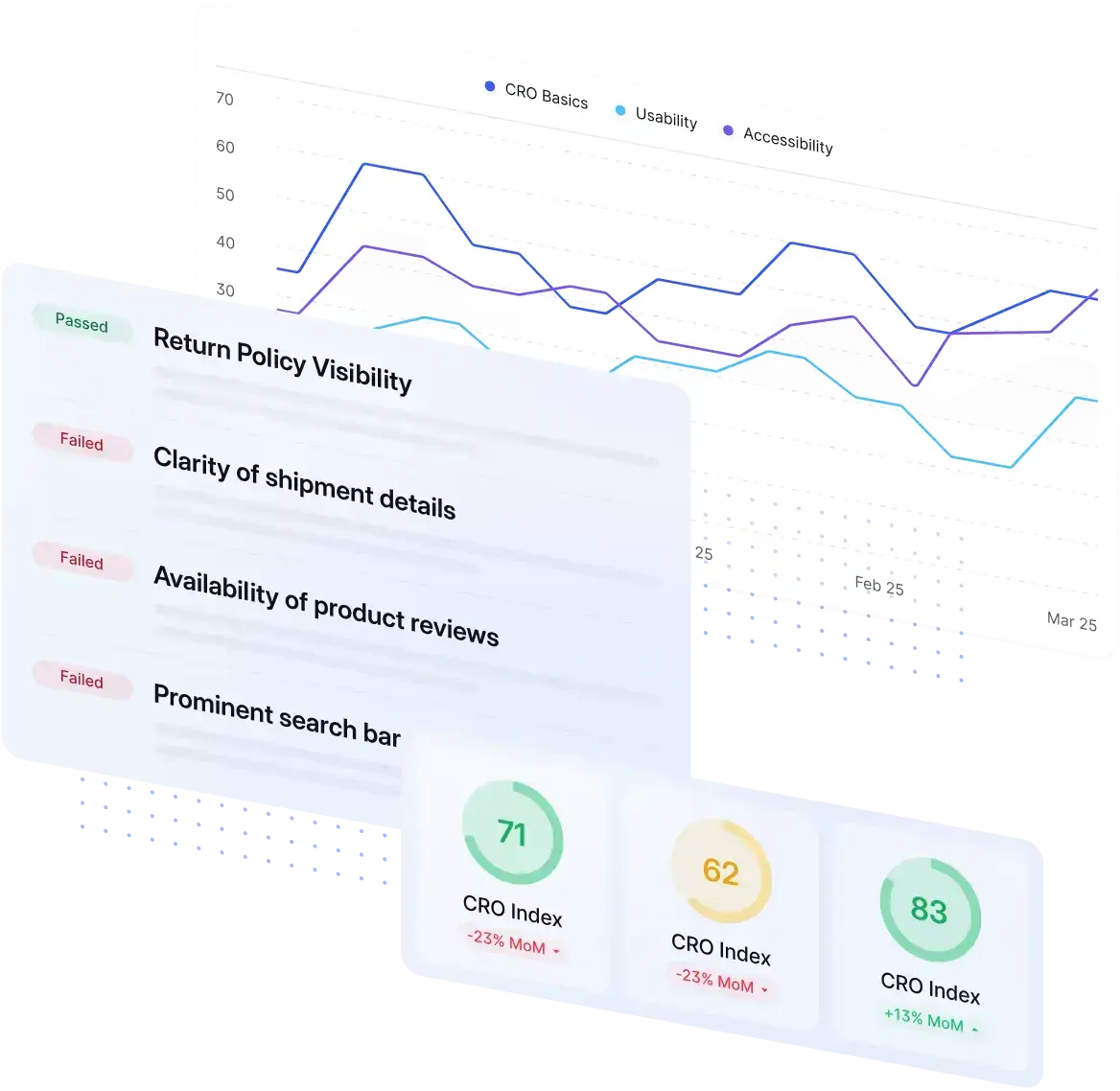
While understanding benchmarks and implementing best practices is essential, the process can be time-consuming and complex. That's where CRO Benchmark comes in. Our AI-driven tool provides a comprehensive CRO audit, analyzing over 250 criteria across your eCommerce store. In just 15 minutes, CRO Benchmark uncovers your biggest conversion leaks and delivers prioritized fixes, tailored A/B testing ideas, and a clear CRO Index Score from 0–100.
What is CRO Benchmark? CRO Benchmark is an AI-driven conversion optimization audit that analyzes 250+ criteria across your eCommerce store. It uncovers your biggest conversion leaks and delivers prioritized fixes, tailored A/B testing ideas, and a clear CRO Index Score from 0–100.
With CRO Benchmark, you can:
- Identify Conversion Leaks: Quickly pinpoint the areas of your website that are costing you conversions.
- Get Prioritized Fixes: Receive actionable recommendations, ranked by their potential impact.
- Generate A/B Testing Ideas: Discover tailored A/B test ideas to improve your website performance.
- Track Your Progress: Monitor your CRO Index Score to see how your website is improving over time.
CRO Benchmark helps you quickly identify and fix the problems that are holding back your conversions. It provides a clear, data-driven path to optimization, saving you time and resources.
Disclaimer: This article includes a promotional section for CRO Benchmark. While we believe in the value of the tool, this should be considered in your evaluation of the content.
Ultimately, Optimize for Success in 2026
Understanding and applying CRO benchmarks is a crucial aspect of success for eCommerce businesses. By focusing on key metrics, analyzing your performance, and implementing the actionable tips outlined in this guide, you can significantly improve your conversion rates and drive revenue growth. Tools like CRO Benchmark can further streamline the process, providing you with the insights and recommendations you need to optimize your website for success in 2026 and beyond. Don't let your website's potential go untapped – start benchmarking and optimizing today.
Takeaways
- Benchmarks provide essential context for understanding your website's performance.
- Focus on key metrics like conversion rate, AOV, and cart abandonment rate.
- Implement actionable improvement tips, such as optimizing website speed and streamlining the checkout process.
- Consider using AI-powered tools like CRO Benchmark to accelerate your optimization efforts.